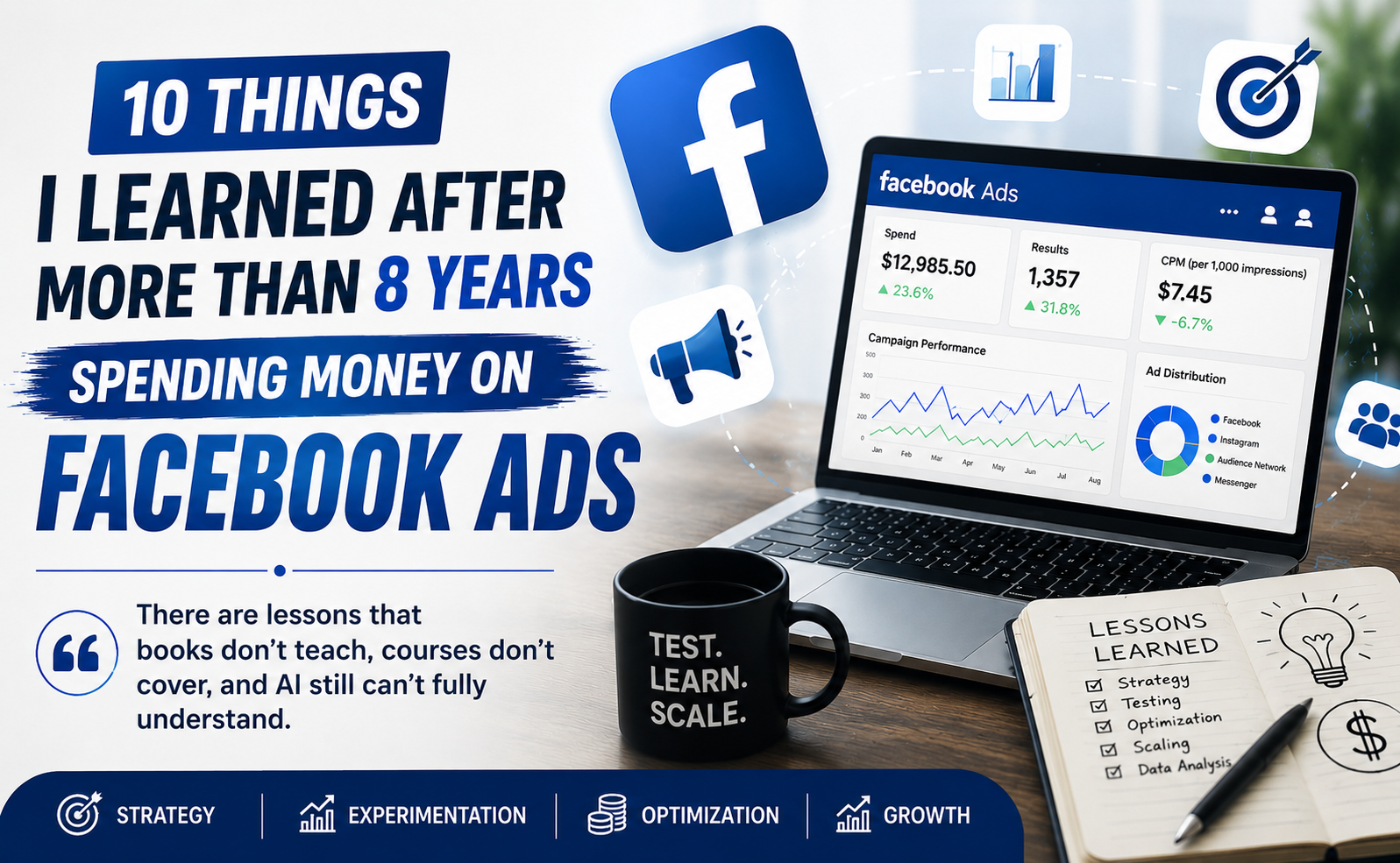
After more than eight years running Facebook advertising campaigns and spending hundreds of thousands of dollars on marketing, I’ve realized one thing: the most valuable lessons are rarely found in books, courses, or official guides.
Facebook Ads is a complex system. The longer you work with it, the more you understand that data, algorithms, and optimization principles are only part of the game. The rest comes from real-world experience, failures, and the budgets you pay in exchange for knowledge.
Here are 10 lessons I’ve learned after spending tens of thousands of hours inside Ads Manager.
1. Sometimes the Problem Isn’t Your Content or Targeting
When a campaign becomes saturated, advertising costs often increase over time. Most advertisers immediately start changing creatives, adjusting audiences, or optimizing landing pages.
However, there are situations where everything appears to be working correctly, yet performance still declines. In those cases, switching to a different ad account can sometimes produce better results than any optimization tactic.
It may sound hard to believe, but many experienced advertisers have encountered this phenomenon.
2. Duplicating Ad Sets Doesn’t Reduce Costs
A common belief is that duplicating ad sets helps discover lower-cost opportunities.
In reality, most of the time, duplication simply causes you to spend more money within the same period. The system is still targeting the same market and reaching the same pool of potential customers.
Duplicating ad sets does not create new demand. It only increases delivery speed.
3. Personal Ad Accounts Can Sometimes Outperform Business Managers
Business Manager was designed for businesses and professional advertising management.
However, after numerous tests, I’ve noticed that many personal ad accounts deliver more stable performance, lower CPMs, and better delivery than some business-managed accounts.
The system doesn’t always operate according to the logic we expect.
4. Prepaid Payments Provide Better Budget Control
Whenever possible, I prefer prepaid payment methods.
The reason is simple: I know exactly how much I’m spending and can manage my budget more effectively. With postpaid credit limits, it’s easy to overspend or encounter financial risks if account issues arise.
Cash flow management remains one of the most important aspects of advertising.
5. Every Fan Page Has Its Own “Personality”
Some Facebook pages seem capable of advertising almost anything successfully.
On the other hand, there are pages where the content is good, the product is good, and the strategy is identical, yet the results fall short of expectations.
After years in the industry, I’ve come to believe that every page has its own history, credibility, and unique signals in the eyes of the platform.
That’s why two seemingly identical campaigns can produce completely different outcomes.
6. Ideas Matter More Than Visual Quality
Many advertisers spend thousands of dollars producing high-end video ads and still fail to generate results.
Meanwhile, a simple video recorded on a smartphone can sometimes outperform them significantly.
The real difference isn’t image quality—it’s the idea behind the content.
A strong concept will often beat an expensive production that lacks a compelling message.
7. Facebook Always Wants to Expand Reach
No matter how precisely you target your audience, the system continuously looks for opportunities to broaden delivery.
Sometimes this helps uncover new customers. Other times, it causes ads to be shown to people who are not truly relevant.
That’s why monitoring data and evaluating conversion quality is far more important than focusing solely on the number of results.
8. You Can Never Completely Eliminate Audience Overlap
Many advertisers use Pixels, Conversion APIs, and advanced tracking tools in an attempt to eliminate duplicate audiences entirely.
In reality, that goal is nearly impossible.
You can reduce overlap, but you cannot remove it completely. It is a natural part of the modern advertising ecosystem.
9. The Market Always Finds a Way
Facebook constantly updates its algorithms and tightens advertising policies.
But like any system, the market always produces people who discover new methods, new strategies, and creative ways to adapt to change.
That’s why the digital advertising industry is always evolving and never stands still.
10. Aggressive Scaling Isn’t Always a Mistake
One of the most common pieces of advice is to increase budgets gradually.
However, real-world experience shows that many campaigns continue to perform exceptionally well even when budgets are increased significantly within a short period.
There is no universal formula that works for every situation. What matters most is understanding your data, your product, and your market.
Conclusion
After many years working with Facebook Ads, I’ve realized that advertising is much more than simply launching campaigns and waiting for results.
It is a continuous process of testing, observing, adapting, and learning from mistakes. Many of the most important lessons in this industry cannot be learned through theory alone—they can only be gained through real experience.
Perhaps that is exactly what makes Facebook Ads both challenging and fascinating.
If you’re also running Facebook Ads, what is the most valuable lesson you’ve learned from your experience?