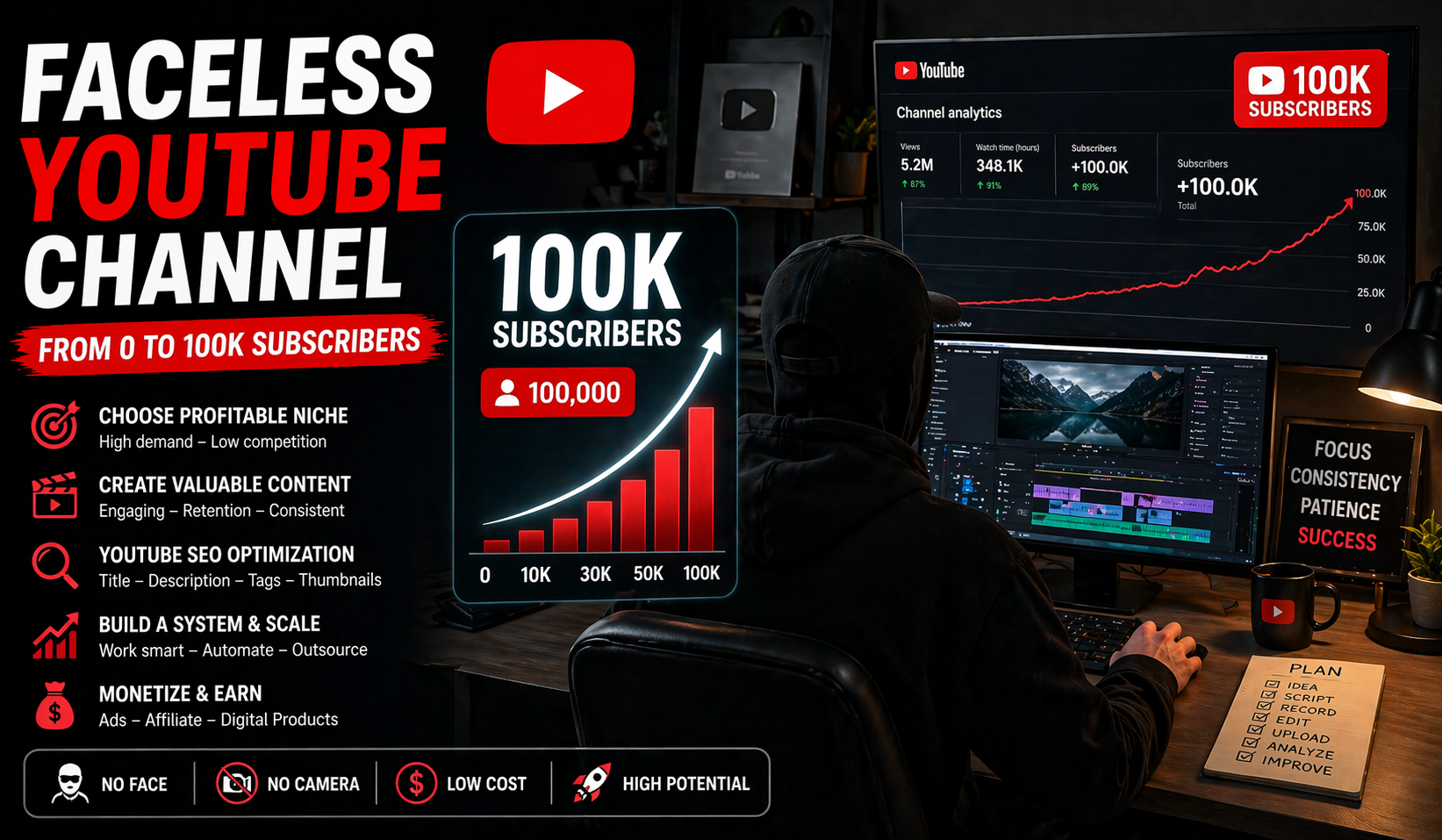
The Biggest Opportunity Most People Misunderstand
Many beginners assume that YouTube success requires confidence on camera, a strong personal brand, or the ability to speak fluently in front of an audience. As a result, they often hesitate before even starting.
However, the landscape in 2026 looks very different.
Thousands of channels are growing rapidly without ever showing a face. These creators remain anonymous, yet their videos consistently reach millions of views and attract large subscriber bases. More importantly, many of these channels generate stable income streams.
This reveals an important shift:
👉 YouTube no longer rewards visibility—it rewards performance
If your content keeps viewers engaged, the platform will continue to promote it, regardless of whether you appear on screen.
Understanding the Core Mechanism: YouTube Is a Retention Game
Unlike short-form platforms that prioritize quick engagement, YouTube operates on a deeper level. Its algorithm is heavily influenced by how long viewers stay and how much of your video they watch.
This means that your success depends on two critical factors:
👉 Retention and watch time
Even without showing your face, you can succeed if you create videos that hold attention. Conversely, even high-quality visuals will fail if viewers lose interest early.
The goal is not to impress viewers—it is to keep them watching.
The Most Common Reason Faceless Channels Fail
Most faceless channels fail not because the idea is flawed, but because the creator does not understand viewer behavior.
They upload videos without a clear strategy, replicate content blindly, and expect results without analyzing performance.
This leads to a cycle of low views, frustration, and eventually quitting.
In reality, success comes from understanding one simple principle:
👉 People don’t watch videos—they watch outcomes
If your content does not promise or deliver something valuable, viewers will leave.
Phase One: Choosing the Right Niche
Your niche determines everything that follows. It defines your audience, your content direction, and your ability to scale.
A strong niche must meet three conditions. It needs consistent demand, meaning people actively search or consume that type of content. It must be compatible with faceless production, allowing you to create videos without appearing on camera. Finally, it should be scalable, giving you enough room to produce dozens or even hundreds of videos without running out of ideas.
Popular faceless niches include storytelling, educational content, finance, self-improvement, technology, and list-based formats.
Choosing the wrong niche often leads to slow growth, regardless of effort.
Phase Two: Building a Repeatable Content Format
One of the biggest mistakes beginners make is treating every video as a new experiment. While testing is important in the beginning, long-term growth requires consistency.
Instead of constantly reinventing your content, you should develop a repeatable format. This format acts as a blueprint that can be applied across multiple videos.
For example, a storytelling channel might always start with a strong hook, build tension through a structured narrative, and end with a twist or insight.
A repeatable format reduces production time, improves consistency, and makes scaling possible.
Phase Three: Mastering the Hook
The first few seconds of your video determine whether viewers stay or leave.
On YouTube, the opening is slightly longer than on short-form platforms, but it is just as critical. Within the first 10 to 15 seconds, viewers decide if the video is worth their time.
A strong hook creates curiosity, sets expectations, and gives viewers a reason to continue watching.
Weak openings, on the other hand, lead to immediate drop-offs, which significantly reduce your video’s chances of being recommended.
Phase Four: Optimizing Retention
Once you capture attention, the next challenge is keeping it.
Retention is influenced by pacing, storytelling, and clarity. Every moment in your video should serve a purpose. Long pauses, unnecessary explanations, or repetitive segments can quickly cause viewers to lose interest.
Effective creators maintain momentum by constantly introducing new elements, asking implicit questions, and guiding the viewer through a structured experience.
The longer viewers stay, the more YouTube trusts your content.
Phase Five: Leveraging YouTube SEO
Unlike TikTok, YouTube functions as both a recommendation engine and a search engine.
This gives you a powerful advantage. A well-optimized video can continue generating views for months or even years.
SEO on YouTube involves optimizing your title, description, and keywords to align with what people are searching for. A strong title should balance curiosity with clarity, while the description provides context that helps the algorithm understand your content.
When done correctly, SEO creates a steady stream of long-term traffic.
Phase Six: Building a Content Library
A single video rarely defines a channel’s success. Growth comes from building a library of content that works together.
Each video increases your chances of being discovered. Over time, your channel becomes a network of interconnected content that keeps viewers engaged across multiple videos.
Consistency plays a critical role here. Regular uploads signal activity and help maintain momentum.
Phase Seven: Scaling What Works
When a video performs well, it provides valuable data. Instead of moving on to completely new ideas, you should analyze what made it successful.
Was it the topic, the structure, the hook, or the pacing?
Once you identify the key factors, you can create variations that replicate the same strengths.
Scaling is not about creating more—it is about repeating what works.
The Real Timeline to 100K Subscribers
Reaching 100,000 subscribers is less about luck and more about consistency and iteration.
In the early stages, you may need dozens of videos to find a format that resonates. As you refine your approach, growth becomes more predictable.
For many creators, the journey involves testing, optimizing, and gradually building momentum over time.
Monetizing a Faceless YouTube Channel
Once your channel gains traction, multiple revenue streams become available.
You can earn through YouTube ads, affiliate marketing, digital products, or even external traffic funnels.
The key advantage of YouTube is that it creates long-term value. Unlike short-form content, which often fades quickly, YouTube videos can continue generating income long after they are published.
The Future of Faceless YouTube
As AI tools make content creation more accessible, competition will continue to increase.
This means that simply producing content will not be enough. Creators will need to focus on quality, structure, and audience understanding.
Those who succeed will not be the ones who produce the most content, but the ones who produce the most effective content.
Conclusion
👉 Building a faceless YouTube channel from 0 to 100K subscribers is entirely achievable
But it requires more than effort.
It requires strategy, consistency, and a deep understanding of how content performs.
Final Insight
👉 YouTube does not require your face
👉 It requires your ability to hold attention