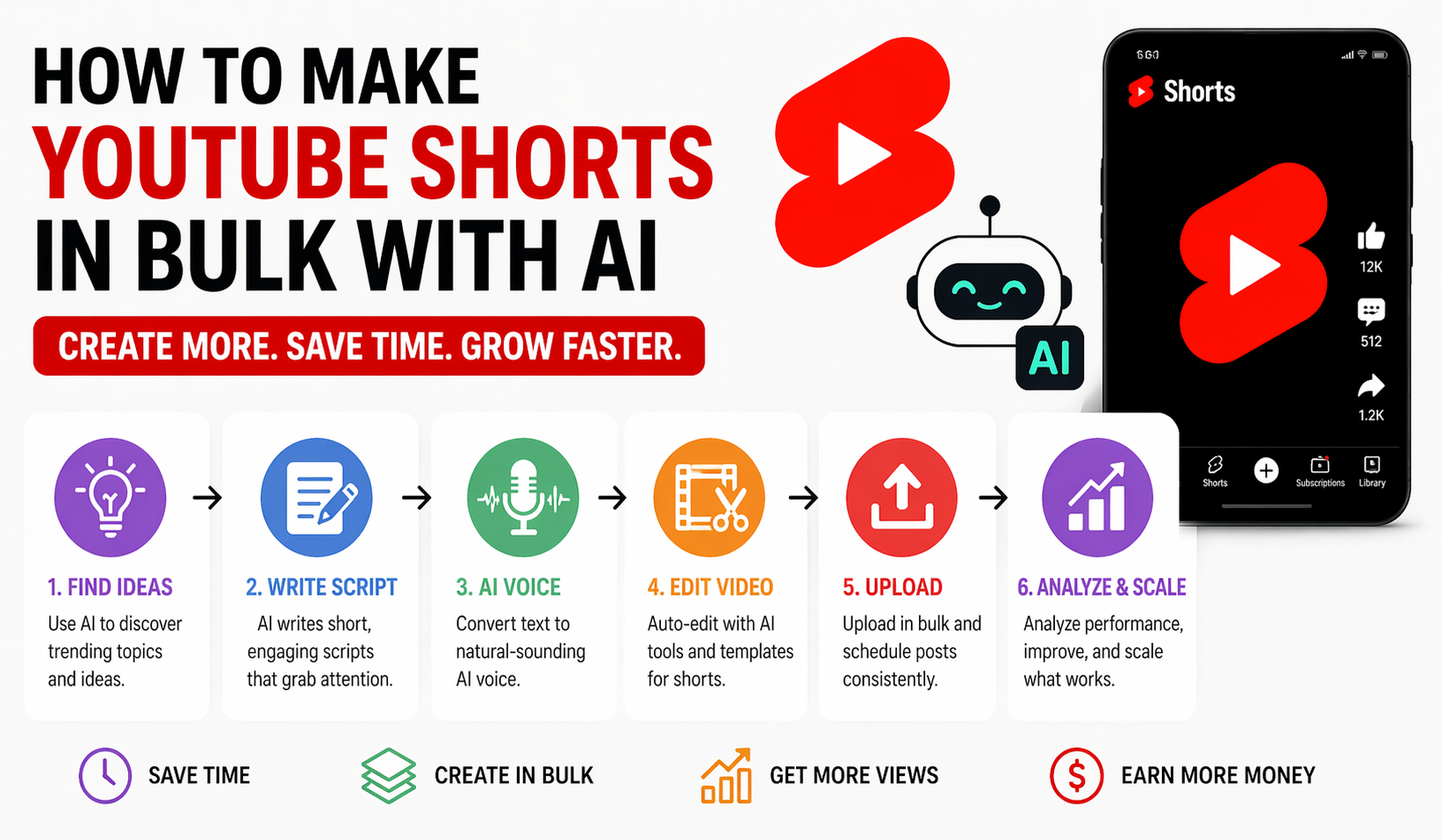
Shorts Is Not Luck — It’s a Game of Volume with Strategy
Over the past few years, YouTube Shorts has become one of the fastest ways to grow a channel. Many creators have built channels from zero to tens of thousands of subscribers in a short period of time.
What makes it even more interesting is that you don’t need:
- High production quality
- Expensive equipment
- On-camera presence
Yet you can still generate massive views.
So what is the real secret behind it?
It is not about creating one perfect video.
👉 It is about producing a high volume of optimized content consistently
This is where AI becomes a powerful advantage. It allows you to scale content production without increasing manual workload.
What Does “Creating Shorts with AI” Actually Mean?
A common misconception is that AI can fully automate video creation with a single click.
In reality, AI acts as a tool that supports each step in your workflow.
A typical process includes:
- Finding content ideas
- Writing scripts
- Generating voiceovers
- Editing videos
- Uploading content
AI helps speed up each of these steps, but you remain in control of strategy and quality.
Step 1: Choosing Content That Has Viral Potential
Many beginners make the mistake of starting with video creation instead of content selection.
However, content is the foundation.
For Shorts to perform well, it must trigger a reaction. This could be curiosity, surprise, emotion, or even controversy.
Content that lacks emotional impact rarely performs, no matter how well it is edited.
Common high-performing formats include quick facts, short stories with a twist, before-and-after transformations, and rapid tips.
If your content does not make viewers feel something, they will scroll past it instantly.
Step 2: Crafting a Strong Hook
On YouTube Shorts, the first few seconds determine everything.
Viewers decide almost instantly whether to continue watching or move on.
A strong hook should immediately create curiosity and deliver a clear reason to keep watching.
Weak openings that introduce the topic slowly often result in immediate drop-offs.
Using AI to generate multiple hook variations can be a powerful way to test different approaches and identify what works best.
Step 3: Writing Short but Engaging Scripts
Shorts do not require long scripts, but they require clarity and pacing.
Every sentence should serve a purpose. There is no room for filler content or unnecessary explanations.
A strong script maintains momentum and keeps the viewer engaged from start to finish.
AI can help generate scripts quickly, but you should always refine them to ensure they feel natural and engaging.
Step 4: Using AI Voice to Increase Production Speed
Instead of recording your own voice, you can use AI-generated voiceovers.
Modern AI voices are natural enough for most content types and can significantly reduce production time.
The key is to choose a voice that matches your content style and adjust pacing to maintain engagement.
A well-delivered voiceover enhances retention and improves the overall viewing experience.
Step 5: Editing for Retention
Editing is one of the most important factors in Shorts performance.
Because Shorts are fast-paced, slow or static visuals can quickly lose viewer attention.
Effective editing includes quick cuts, continuous motion, on-screen text, and visual highlights that reinforce the message.
Templates and AI-assisted tools can help streamline this process and maintain consistency across multiple videos.
Step 6: Batch Production for Maximum Efficiency
Creating videos one by one is inefficient and difficult to scale.
Instead, you should adopt a batch production workflow.
For example, you can dedicate one session to writing scripts, another to generating voiceovers, and another to editing videos.
This approach reduces context switching and allows you to produce content much faster.
Batching is one of the key differences between casual creators and scalable systems.
Step 7: Publishing and Continuous Testing
YouTube Shorts does not require complex SEO strategies, but it does require consistency.
Publishing multiple videos per day increases your chances of discovering what works.
Testing different formats, hooks, and styles allows you to gather data quickly and refine your approach.
Instead of relying on intuition, you should rely on performance data to guide your decisions.
Step 8: Scaling What Works
One of the biggest mistakes is moving on too quickly after a successful video.
When a video performs well, it provides valuable insight.
You should analyze why it worked and create multiple variations based on the same concept.
Scaling is not about creating new ideas constantly—it is about expanding proven ideas.
Automation: Moving from Manual Work to Systems
As your content volume increases, managing everything manually becomes inefficient.
Automation tools can help with scheduling, file management, and performance tracking.
This allows you to focus on strategy and optimization rather than repetitive tasks.
Over time, your workflow evolves into a system that can operate with minimal manual input.
Realistic Timeline for Results
YouTube Shorts is not an instant success model.
In the beginning, you will focus on testing and learning.
As you publish more videos and analyze results, patterns will emerge.
Growth becomes more consistent once you identify what works and scale it effectively.
Monetization Opportunities
Shorts can generate income in several ways.
You can earn through the YouTube Shorts fund, affiliate marketing, or by directing traffic to longer videos and other platforms.
Shorts primarily act as a traffic engine, while monetization often comes from the system behind the content.
Conclusion
👉 Creating YouTube Shorts in bulk using AI is completely achievable
But it is not about spamming content.
It is about combining the right content strategy, efficient workflows, and continuous testing.
Final Insight
👉 Not every video will go viral
👉 But with enough optimized content, some inevitably will