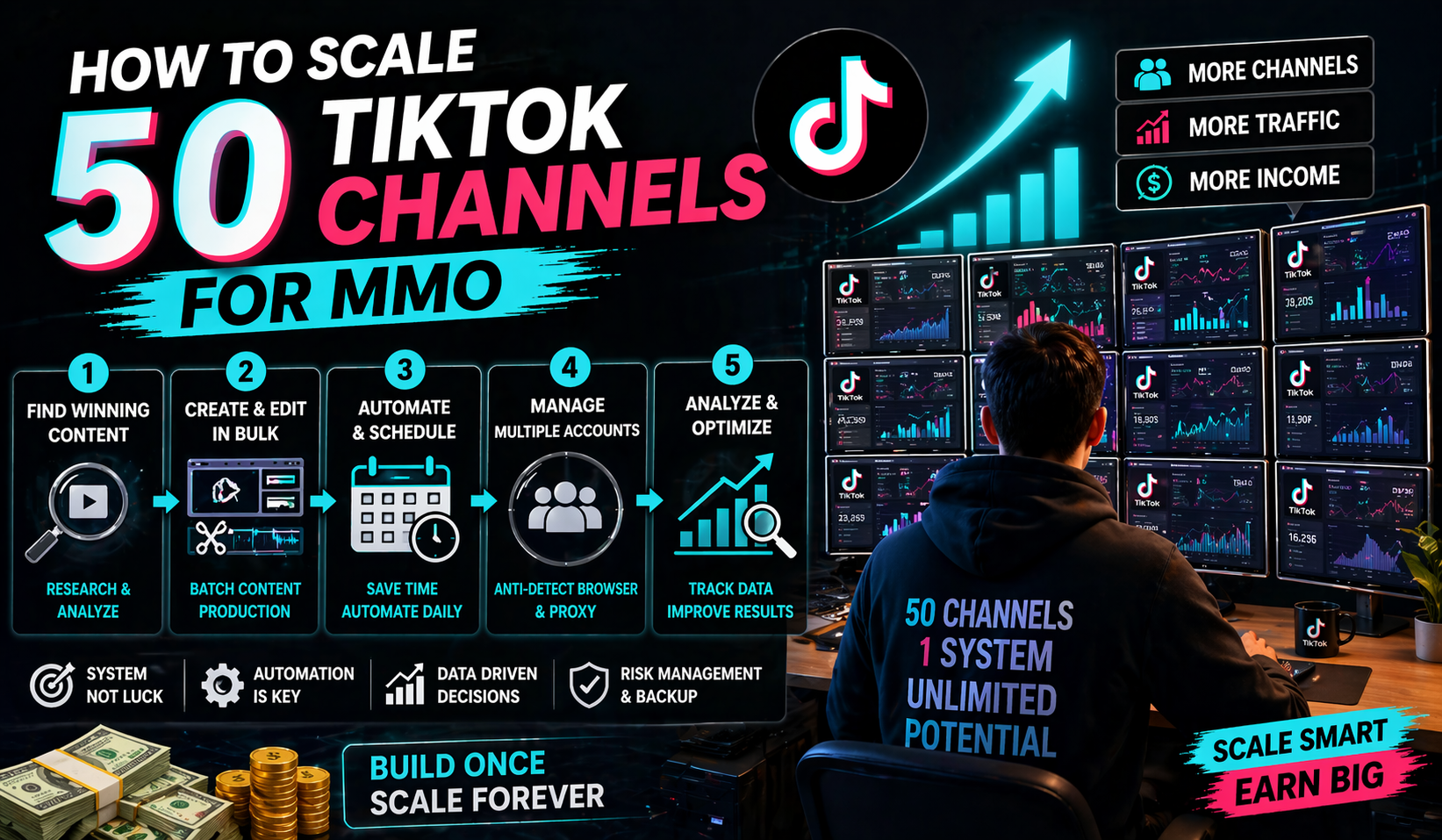
From One Channel to Fifty – The Real Challenge
When most people start working with TikTok, they focus entirely on building a single channel. They spend time optimizing content, testing different formats, and trying to create viral videos. This is a necessary step, but it is only the beginning.
The real limitation appears when everything depends on just one channel.
TikTok is fundamentally a game of probability. Not every video will perform well, and even successful channels can experience unpredictable drops in reach. If your entire strategy relies on one account, your growth will always be unstable.
This is why experienced MMO marketers rarely stop at one channel.
Instead, they build multi-channel systems and gradually scale to 10, 20, or even 50 channels.
At this point, the key question becomes:
👉 How can one person realistically manage and scale 50 TikTok channels?
The answer is not about working harder.
👉 It is about building the right system.
The Right Mindset: Scaling Is Not Multiplying Work
One of the biggest misconceptions beginners have is believing that managing 50 channels means doing 50 times more work.
In reality, this approach would quickly lead to burnout.
A scalable system works differently.
👉 Fifty channels are simply outputs of a single optimized workflow
Instead of creating separate processes for each channel, you design one efficient system and replicate it. Once that system is running smoothly, adding more channels increases output without significantly increasing effort.
Phase One: Building a Strong Foundation
Before scaling to dozens of channels, you must first prove that your content works.
This means you need at least one or two channels that demonstrate consistent performance. You should understand what type of content resonates with your audience, which formats generate engagement, and what drives views.
Without this foundation, scaling becomes dangerous. You are not multiplying success—you are multiplying failure.
During this phase, your focus should remain on testing. Try different content formats, analyze performance, and identify patterns. This stage is less about volume and more about learning.
Phase Two: Systemizing Your Workflow
Once you have identified a winning content strategy, the next step is to transform your process into a repeatable system.
A typical TikTok content system includes several stages: sourcing content ideas, scripting, video creation, publishing, and performance tracking.
Each of these steps needs to be optimized for speed and consistency. Instead of creating videos one by one, you should batch your work. For example, you can write multiple scripts in one session and produce several videos using templates.
The goal is to reduce decision-making and increase efficiency.
Without systemization, scaling is almost impossible.
Phase Three: Replicating Winning Content
A common mistake is assuming that scaling requires constantly creating new ideas.
In reality, successful scaling is based on replication.
When a video performs well, it becomes a proven asset. You can create multiple variations of that video by adjusting the hook, changing the narrative slightly, or modifying the visuals.
This approach allows you to produce more content without starting from scratch each time.
In many cases, a single successful idea can generate several new videos, each with its own potential to perform.
Phase Four: Expanding Gradually from 1 to 50 Channels
Scaling should always be gradual.
You do not jump directly from one channel to fifty. Instead, you move step by step. You start with one or two channels, then expand to five or ten, and only move to larger numbers once your system is stable.
At each stage, your focus should be on control.
If you expand too quickly, you risk losing track of performance data, mismanaging content, and facing multiple account issues at the same time.
A controlled scaling process ensures stability and long-term growth.
Automation: The Key to Large-Scale Operations
When managing multiple channels, manual work quickly becomes inefficient.
Automation tools allow you to schedule posts, manage multiple accounts, and track performance more effectively. They do not replace strategy, but they reduce repetitive tasks and minimize errors.
With automation in place, your role shifts from execution to oversight.
You are no longer focused on uploading videos manually. Instead, you focus on improving the system itself.
What Managing 50 Channels Actually Looks Like
Once your system is fully operational, your daily tasks become surprisingly simple.
You are no longer spending hours creating individual videos. Instead, your time is divided between monitoring performance, optimizing content, and making strategic decisions.
In many cases, managing a large system can take just a few hours per day when everything is properly structured.
This is the true power of automation and systemization.
Risk Management in Multi-Channel Systems
Scaling comes with risks, especially when dealing with multiple accounts.
Some channels may lose reach, others may face restrictions, and some may stop performing altogether. This is normal and expected.
The key is to design your system in a way that absorbs these risks.
Diversifying content, maintaining backup accounts, and avoiding repetitive patterns all help protect your overall operation.
You should never rely on a single channel or a single source of traffic.
Common Mistakes When Scaling TikTok Channels
Many people attempt to scale too early, before they have identified a winning content strategy. Others try to manage everything manually, which quickly leads to inefficiency.
Another critical mistake is ignoring data.
Without understanding which videos perform well and why, you cannot improve your system. Scaling without data is essentially guessing at a larger scale.
Building a Sustainable Scaling Strategy
True scaling is not about speed—it is about sustainability.
You need to continuously test new ideas, refine your content, and maintain the stability of your system. Growth should be controlled and intentional.
A well-built system allows you to expand over time without losing efficiency.
The Future of MMO: System-Based Growth
As we move into 2026, the MMO landscape is becoming increasingly competitive.
Single-channel creators will struggle to keep up, while those without structured systems will find it difficult to scale.
The advantage will belong to creators who understand how to build and operate systems.
Conclusion
👉 Scaling 50 TikTok channels is absolutely possible
But it cannot be achieved through manual effort alone.
It requires a combination of systems, automation, and data-driven decision-making.
In modern MMO, success is no longer about working harder.
👉 It is about building smarter systems that work for you.
Final Insight
👉 The winners are not those who produce the most content
👉 But those who build the most efficient systems