Over the past year, one trend has become impossible to ignore:
the difference between a high-performing video and a failed one often comes down to a single factor — the opening.
You can have the same content, the same creator, and the same effort.
But simply changing how a video starts can completely change the outcome.
Some videos with average content still perform well, holding viewers and gaining consistent views.
Meanwhile, others with well-researched, high-quality information lose viewers within seconds.
In most cases, the problem isn’t the content.
It’s the hook.
Hooks Are No Longer Just “A Good Sentence”
In the past, a hook was often defined as a catchy opening line.
In 2026, that definition no longer applies.
A hook is now a combination of signals that appear within the first seconds of a video — designed to interrupt scrolling and capture attention instantly.
Today’s users don’t actively choose what to watch.
They scroll quickly, consume content passively, and move on without thinking.
This means you’re not competing with one video.
You’re competing with an entire feed.
And in that environment, you don’t have five seconds.
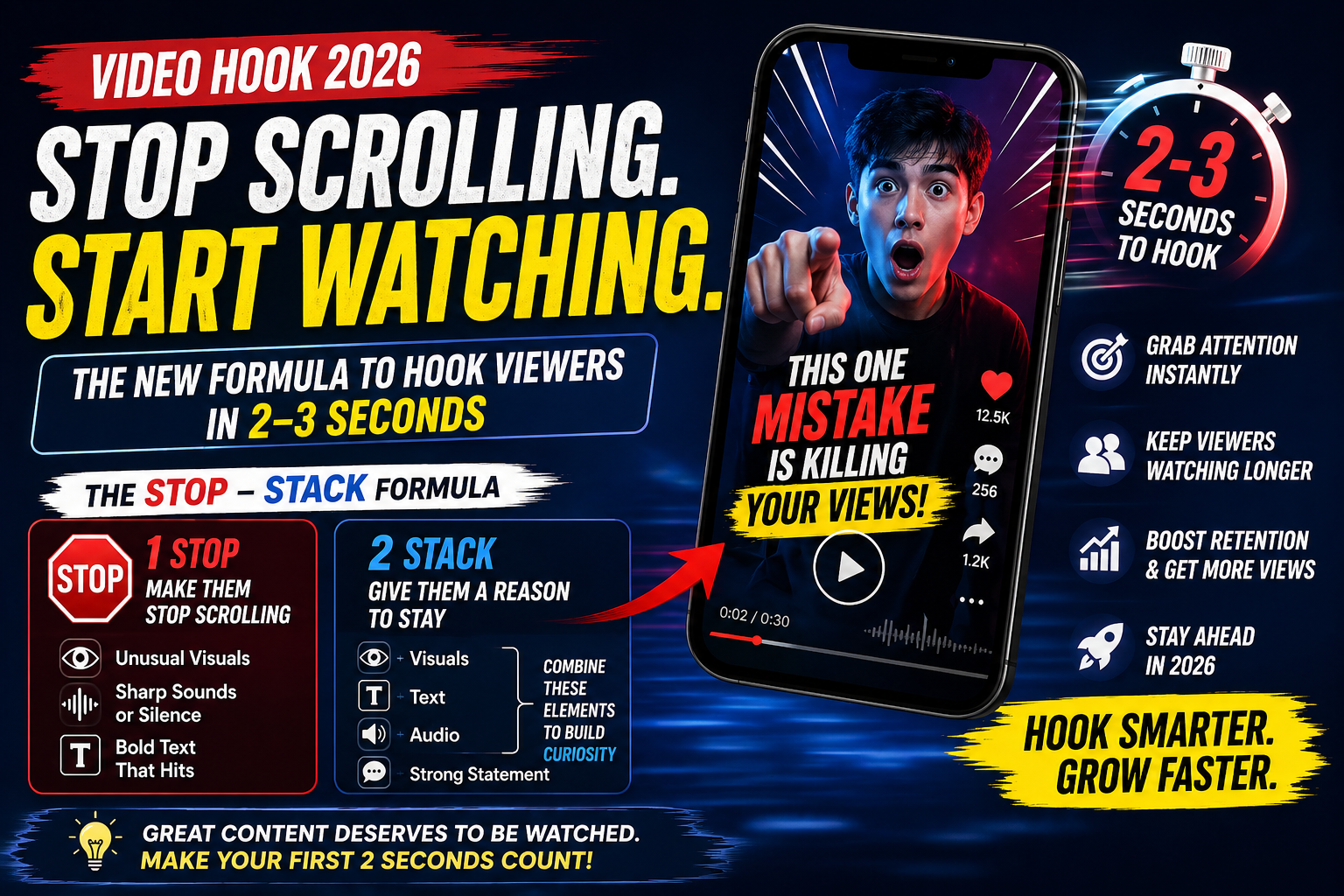
You have 2–3 seconds at most.
The STOP – STACK Framework
To adapt to this behavior, many creators are shifting to a simple but powerful approach: STOP – STACK.
This framework focuses on two stages:
first, getting the viewer to stop, and then giving them a reason to stay.
STOP: Make Them Pause
Before a viewer understands your message, they need to stop scrolling.
This is where most creators fail.
They try to explain, educate, or impress — before the viewer is even paying attention.
To create that pause, you need to break the viewer’s scrolling pattern with something unexpected.
This can be done through:
- Visual disruption: an unusual angle, unexpected action, or something out of context
- Audio cues: a sharp sound, a snap, or even a sudden moment of silence
- On-screen text: a short, direct statement that sparks curiosity
For example:
“Your video isn’t getting views… and it’s not the algorithm.”
That single line is often enough to make someone stop — even for just a second.
STACK: Give Them a Reason to Stay
Getting attention is only half the job.
If you don’t reinforce it, the viewer will scroll away just as quickly.
This is where STACK comes in — layering multiple signals at once to hold attention.
Instead of relying on one element, combine them:
- Visual + Text: an unusual image supported by a strong message
- Visual + Voice: a different camera angle paired with a bold statement
- Visual + Audio: a small action enhanced by a clear sound
For instance:
“I wasted six months because I misunderstood this one thing.”
Paired with a unique visual, this creates both curiosity and emotional engagement.
The Most Common Mistake
Many creators get the sequence wrong.
They start by explaining.
They focus on delivering value immediately.
But they forget one thing:
the viewer hasn’t stopped to listen yet.
No matter how good your content is, it won’t matter if no one stays long enough to hear it.
The Correct Order
The right sequence is simple:
👉 STOP first → STACK second
If you can’t make people pause,
you won’t get the chance to make them stay.
Conclusion
If your videos aren’t getting views, the problem may not be your content strategy.
It may be your first few seconds.
Before changing your topic or tools, go back and analyze your opening:
- Does it interrupt scrolling?
- Does it create curiosity?
- Does it give viewers a reason to stay?
In 2026, great content alone is no longer enough.
👉 The ability to capture and hold attention instantly is what truly determines performance.