When YouTube Becomes a System, Not a Job
For most beginners, YouTube is seen as a content creation job. You come up with ideas, record videos, edit them, upload, and repeat the process day after day.
While this approach works at a basic level, it quickly reaches its limits.
Your time is finite. Your energy is limited. And eventually, your growth slows down because everything depends on you.
This is where the concept of YouTube Automation becomes powerful.
Instead of treating YouTube as a manual process, you begin to treat it as a system—one that can produce content, generate traffic, and create income with minimal direct involvement.
What Is YouTube Automation? (The Real Definition)
YouTube Automation is not about using a tool to automatically generate videos.
That is a common misconception.
At its core, YouTube Automation is about building a structured workflow where content production is systemized, delegated, or supported by tools, allowing videos to be created consistently without you doing everything yourself.
In this model, you are no longer the creator in the traditional sense.
👉 You become the architect of the system.
You define the niche, the content direction, the production standards, and the optimization strategy. The actual execution—writing scripts, creating voiceovers, editing videos—can be handled by a team, freelancers, or AI-assisted tools.
The Key Difference: Creator vs System Builder
A traditional content creator is limited by personal capacity. They can only produce as much as their time and skills allow.
A system builder, on the other hand, operates differently.
By designing a repeatable process, they can scale content production beyond personal limitations. They can run multiple channels, publish consistently, and expand output without increasing workload proportionally.
👉 Creators make money from videos
👉 System builders make money from systems that produce videos
Why YouTube Automation Is Growing Rapidly
Several factors are driving the rise of this model.
First, AI and digital tools have significantly reduced production costs. Tasks like scriptwriting, voiceovers, and even editing can now be completed faster and more efficiently than before.
Second, YouTube remains one of the most powerful long-term platforms. Unlike short-form content that fades quickly, YouTube videos can continue generating views and income for months or even years.
Third, the model allows for multi-channel scalability. Because you are not tied to a personal brand, you can operate multiple channels simultaneously, each targeting a different audience or niche.
How YouTube Automation Generates Income
A successful YouTube Automation system does not rely on a single video. Instead, it leverages consistency and volume combined with strong content performance.
Revenue can come from multiple sources.
YouTube AdSense provides income based on views and watch time. Affiliate marketing allows you to earn commissions by promoting products within your videos. You can also sell digital products, services, or direct traffic to external platforms.
The most important advantage is that videos continue working even when you are not actively involved.
👉 Your system keeps producing results in the background.
Phase One: Choosing the Right Niche
Everything begins with niche selection.
A strong niche must have consistent demand, meaning there is a steady audience interested in that type of content. It should also be suitable for faceless production, allowing you to create videos without appearing on camera.
Finally, it must be scalable. You need enough content ideas to produce dozens or even hundreds of videos without running out of topics.
Popular niches for automation include storytelling (such as crime, history, or mystery), finance and self-improvement, educational facts, and lifestyle content.
Choosing the wrong niche will limit your growth regardless of how well you execute.
Phase Two: Building a Standardized Workflow
A system cannot function without structure.
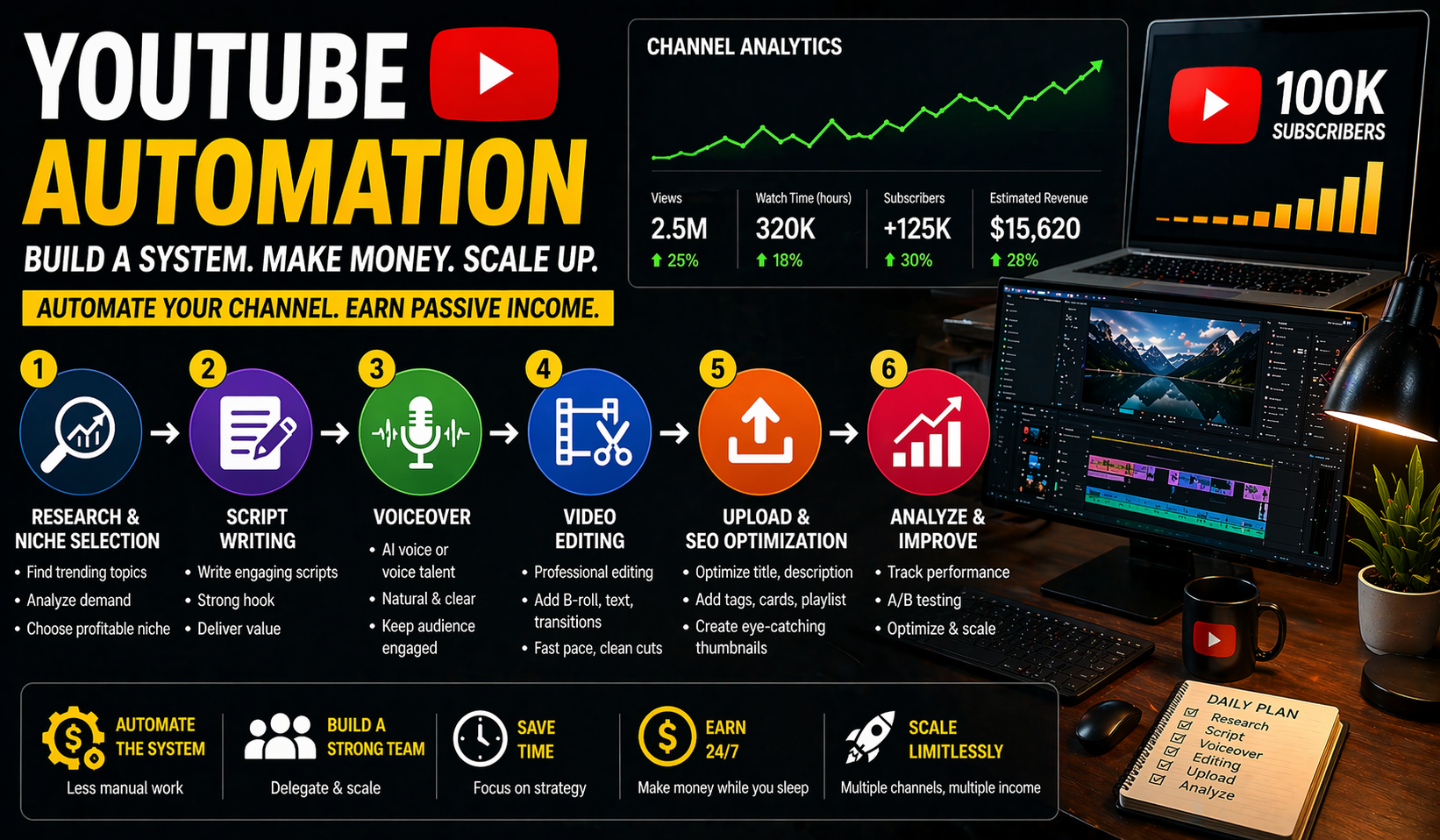
Your workflow should clearly define each stage of content production. This includes researching topics, writing scripts, generating voiceovers, editing videos, uploading content, and analyzing performance.
Each step must be repeatable and consistent. This is what allows you to delegate tasks or integrate tools effectively.
Instead of relying on creativity for every video, you rely on a proven process.
Phase Three: Retention as the Core Metric
Automation does not mean sacrificing quality.
In fact, retention becomes even more critical.
If your videos fail to keep viewers engaged, they will not be recommended by the algorithm. This applies regardless of how efficient your system is.
Strong retention requires clear structure, engaging pacing, and continuous viewer interest. Every second of your video should contribute to keeping the audience watching.
Phase Four: Leveraging YouTube SEO
Unlike platforms that rely purely on recommendations, YouTube also functions as a search engine.
This creates an opportunity for long-term traffic.
By optimizing your titles, descriptions, and keywords, you can ensure that your videos appear in search results. This allows your content to generate views long after it has been published.
SEO is what transforms your system from short-term traffic into long-term income.
Phase Five: Scaling the System
Once your system produces consistent results, scaling becomes the next step.
This can involve increasing your publishing frequency, creating variations of successful content, or launching additional channels.
The key is replication.
Instead of constantly creating new ideas, you focus on expanding what already works.
This is where YouTube Automation truly shows its potential.
Common Mistakes in YouTube Automation
Many beginners misunderstand automation as an easy shortcut.
In reality, it requires a deeper level of thinking. You must understand content, audience behavior, and system design.
Another common mistake is outsourcing without control. Without clear guidelines, quality becomes inconsistent, which negatively affects performance.
Finally, some people attempt to scale without understanding their own content. Without insight, scaling only amplifies inefficiencies.
The Real Timeline for Results
YouTube Automation is not a quick-win model.
In the early months, you will focus on testing and refining your system. Over time, as your process improves, results begin to appear.
Long-term success comes from consistency and continuous optimization.
The Future of YouTube Automation
As content creation becomes more accessible, competition will continue to increase.
However, this does not eliminate opportunity—it shifts it.
The advantage will belong to those who can build efficient systems, understand data, and scale intelligently.
Conclusion
👉 YouTube Automation is not about making money quickly
It is about building a system that generates income over time.
When done correctly, it allows you to move from manual work to scalable growth.
Final Insight
👉 You don’t make money from videos
👉 You make money from the system that produces those videos