Before building a content channel, many people face the same problem:
They don’t know what they have to share.
The truth is, it’s not that you lack content—it’s that you’re being held back by a few common mental barriers.
The Barriers That Stop You From Recognizing Your Value
1. “This is too basic—everyone already knows it”
This is the most common trap.
You assume that what you know is too simple, too obvious, and not worth sharing.
But the reality is:
Your experiences, your way of doing things, and your perspective are completely unique.
Even something as simple as cooking instant noodles can be different from person to person. And the way you tell that story is already valuable content.
2. “I’m not good enough to teach others”
This is known as impostor syndrome.
Many people believe they need to be highly successful or extremely skilled before they can share anything.
But in reality:
You don’t need to teach people who are ahead of you.
You just need to share with people who are where you were 1–2 years ago.
For example:
- Someone who lost 5kg can help someone trying to lose 5kg
- A beginner can guide another beginner
You don’t need to be an expert.
You just need to share your real experiences.
3. Chasing trends (FOMO)
When starting out, many people constantly look outside:
- They follow whatever trend is going viral
- They copy what others are doing
The result:
You end up creating content that isn’t truly yours.
You feel forced and exhausted.
And eventually, you quit.
4. Fear of being judged
Common thoughts include:
- What if people I know see this?
- What if my content gets no views?
- What if I receive negative comments?
The truth is:
Most people are too busy with their own lives to focus on yours.
And if you stay authentic, you have nothing to fear.
How to Find Your Own “Content Gold”
There’s a powerful idea once shared by Steve Jobs:
You can’t connect the dots looking forward.
You can only connect them looking backward.
This applies perfectly to your personal journey.
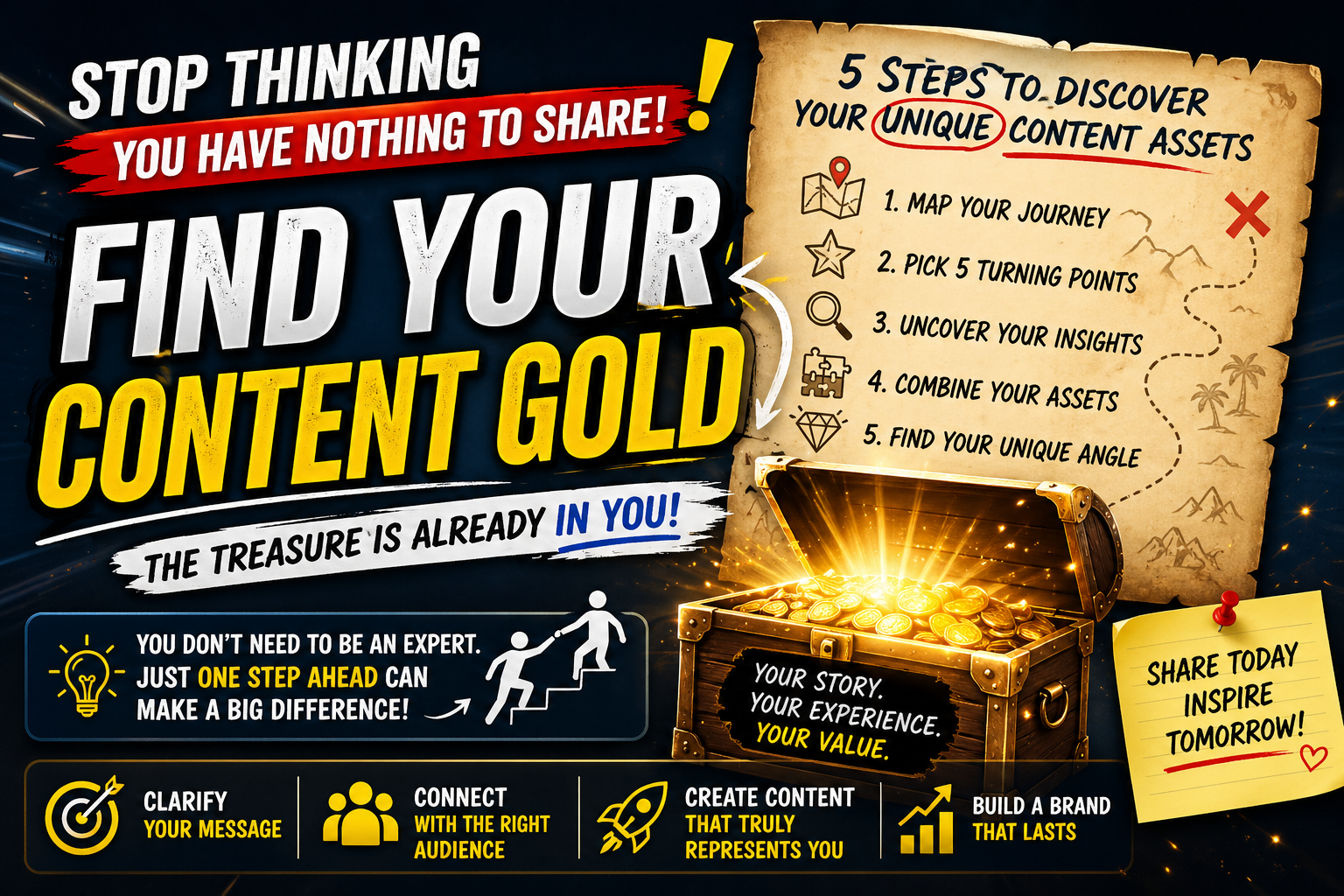
Step 1: Map out your life journey
Write down:
- Important milestones
- Key experiences
- Emotional highs and lows
Break them into stages:
- Childhood
- Teenage years
- Early adulthood
- Present
Be as detailed as possible.
Step 2: Identify your 5 biggest turning points
From everything you’ve listed, choose the 5 most impactful moments.
These could be:
- Major failures
- Important achievements
- Difficult periods
- Life-changing decisions
Step 3: Extract insights from your experiences
Ask yourself:
- How did I overcome my lowest moments?
- What did I do to achieve my best results?
- Are there any patterns that repeat?
- What is the biggest problem I’ve solved?
- If I could go back, what advice would I give my past self?
These answers will reveal:
- Your skills
- Your values
- Your unique perspective
Step 4: Turn it into content assets
A simple formula:
Content assets = Skills + Experiences + Perspective + Values + Lessons
When combined, they create a clear direction for your content.
For example:
- Fitness + cooking → healthy lifestyle content
- Storytelling + current events → storytelling-based analysis content
Step 5: Find your unique angle
This is what makes your content stand out.
Ask yourself:
- What beliefs do I have that differ from the majority?
- What part of my story goes against common assumptions?
These “contrarian” angles are often your strongest content assets.
Conclusion
You don’t lack ideas.
You just haven’t looked deeply enough into your own journey.
When you take the time to reflect, write things down, and connect your experiences, you’ll realize:
You already have more content material than you think.
And one final point:
Don’t aim for instant success.
Instead, focus on mastery:
- Master idea generation
- Master storytelling
- Master filming and editing
Once you become consistent and skilled, success will follow naturally.